Hubble Heritage Archive · Galaxy
NGC 253, the Sculptor Galaxy: Hubble's Hunt for Super Star Clusters
A dusty, edge-on spiral forming stars at a furious rate, where the newly repaired Hubble found four of the most massive young clusters known.
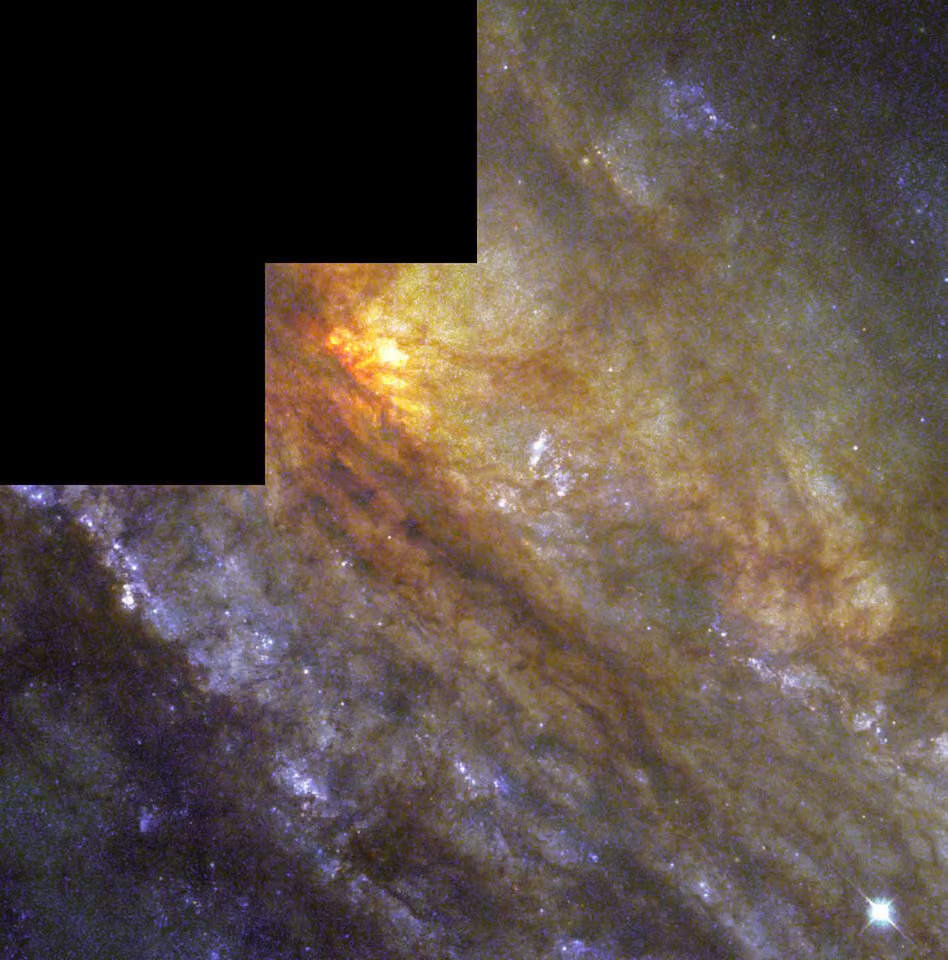
Caroline Herschel found NGC 253 in 1783 while she was sweeping the sky for comets. She had come across one of the nearest large galaxies beyond the Milky Way's immediate neighborhood: a big spiral, tilted almost edge-on, in the southern constellation Sculptor. It is also known as the Sculptor Galaxy and the Silver Coin Galaxy.
Hubble's view is of the core. Clumpy gas clouds, dark dust lanes and luminous clusters of young stars crowd the field, the ingredients of a galaxy forming stars much faster than the Milky Way does. NGC 253 is a starburst galaxy, and the data behind this Heritage image were taken to find out what kind of star clusters such a galaxy makes.
Data from the repaired telescope
The exposures were made on May 29, 1994, with the Wide Field and Planetary Camera 2, only a few months after astronauts on a Space Shuttle mission in 1993 had installed new instruments that corrected Hubble's optics. The observing team, led by Alan Watson, Jay Gallagher and John Trauger, used three filters, from near-ultraviolet to near-infrared, for a total of 1.5 hours. The Heritage Team turned those archival frames into a color picture and released it on December 3, 1998.
| Filter | What it records | Shown as |
|---|---|---|
| F336W (U) | Near-ultraviolet light | Blue |
| F555W (V) | Visible light | Green |
| F814W (I) | Near-infrared light | Red |
The filters run in wavelength order, blue for the ultraviolet frame and red for the near-infrared. Dust absorbs ultraviolet and blue light far more strongly than infrared, so the dust lanes appear brown and the youngest clusters, rich in ultraviolet light, stand out in white and blue where the dust thins. Peering Through the Dust explains why the red end of the set sees farther in.

The comparison above, published in 1995, shows the scale. The ground-based image on the left covers the whole galaxy, and the small box at its center is all that Hubble's camera recorded at full resolution.
| Names | NGC 253, Sculptor Galaxy, Silver Coin Galaxy |
|---|---|
| Type | Nearly edge-on starburst spiral galaxy |
| Constellation | Sculptor |
| Distance | About 7.5 million light-years (2.3 megaparsecs) in the 1998 release |
| Field shown | 2.7 arcminutes, roughly 5,800 light-years, on the vertical side |
| Position (J2000) | R.A. 00h 47m 33.13s, Dec. −25° 17′ 17″ |
| Camera | Wide Field and Planetary Camera 2 |
|---|---|
| Observed | May 29, 1994 |
| Exposure | 1.5 hours |
| Released | December 3, 1998 |
A question that started on the ground
The motivation goes back to work that Chip Arp and Allan Sandage published in 1985. They studied two bright knots in the dwarf galaxy NGC 1569. From the ground the knots were unresolved, indistinguishable from ordinary stars in the Milky Way that might simply lie in front of the galaxy. By analyzing the knots' spectra, Arp and Sandage showed they were probably not foreground stars and suggested they were massive, compact clusters of young stars inside the dwarf galaxy itself.
Hubble tested that idea even before its repair. Images by O'Connell, Gallagher and Hunter showed the knots were larger than point-like stars, so they had to be clusters in NGC 1569. Their properties were extreme: hundreds of luminous stars and about half a million solar masses packed into a region only about 5 light-years across, roughly the distance from the Sun to its nearest neighbor. To mark the difference from ordinary clusters they were called super star clusters.
Why NGC 253 mattered
Two questions followed. How can that much gas be compressed into so small a volume to make a cluster? And could super star clusters be young versions of the globular clusters, the ancient star balls that orbit the Milky Way and date from its youth? The second question links them to the history of the Milky Way itself.
With the impaired telescope, Jon Holtzman and colleagues found similar clusters in the interacting galaxy NGC 1275, and more turned up in other dwarf and interacting galaxies. What remained untested was the hardest setting: the bright, crowded center of a starburst spiral. That needed the repaired Hubble. NGC 253, described by the team as the nearest starburst spiral, was the natural target, and the 1994 images revealed four super star clusters in its core.
That completed the set. Super star clusters had now been found in dwarf galaxies, interacting galaxies and starburst spirals, every kind of place with intense star formation. The team concluded that the type of galaxy does not matter: wherever stars form at a high enough rate, such clusters appear. If the process is that robust, it may also have operated when the Milky Way was young and forming its globular clusters, which strengthens the link between the two.
Questions readers ask
Who discovered NGC 253?
Caroline Herschel discovered it in 1783 while searching for comets. Being so near, it suits both southern-hemisphere amateurs and professionals who study how spirals are put together.
What is a super star cluster?
It is an extremely massive, compact group of young stars, holding roughly 500,000 solar masses in a region roughly 5 light-years across. They were first confirmed in the dwarf galaxy NGC 1569 and later found in interacting and starburst galaxies such as NGC 253.
Why is NGC 253 called a starburst galaxy?
It forms stars far faster than ordinary spirals such as the Milky Way or the Andromeda galaxy, especially in its central region. That activity makes its core bright and crowded, full of young clusters and glowing gas. Those conditions made it the test case for whether super star clusters form in the centers of spirals.
How far away is NGC 253?
The 1998 Heritage release gave about 7.5 million light-years. The observing team's own account of the study used about 10 million light-years, and other estimates differ as well. Either way it is among the nearest large galaxies outside the Local Group.