Hubble Heritage Archive · Supernova remnant
Supernova 1987A: Hubble's Rings Around an Exploded Star in the LMC
The closest supernova seen in centuries, caught by neutrino detectors on Earth, then watched by Hubble every year since 1990 as its debris hits a ring.
At about 7:36 in the morning, Greenwich time, on February 23, 1987, a water tank 1,000 meters underground in a Japanese mine recorded nine neutrinos in two seconds. Detectors in an Ohio salt mine and beneath the Caucasus caught their own handful at the same moment. The particles had come from a star that had just collapsed in the Large Magellanic Cloud, a small galaxy next to the Milky Way. Astronomers in the Southern Hemisphere saw the explosion itself that same day, and SN 1987A became the best-studied supernova in history.
At about 168,000 light-years, it is close enough that every telescope in the Southern Hemisphere turned toward it. Hubble was not yet in orbit when the star exploded. It launched in April 1990, and its first images of the supernova, taken on August 23-24, 1990 with the European Space Agency's Faint Object Camera, already showed the inner ring around it in fine detail. The telescope has returned at least once a year since.
Twenty-five neutrinos
The Kamiokande II detector in the Kamioka mine was a cylindrical tank about 16 meters wide and 16 meters high, holding about 3,000 metric tons of water. After its first nine neutrinos it recorded three more 9 to 13 seconds later. The IMB detector in Ohio counted eight within about six seconds, and the Baksan detector under Mount Andyrchi in the North Caucasus recorded five. That makes 25 neutrinos detected on Earth from an explosion that released an almost unimaginably larger number.
Neutrinos are produced in vast numbers when the core of a massive star collapses, and they pass through ordinary matter so rarely that nearly all of them could cross the whole Earth unstopped. Two dozen were enough. Their timing and energies matched theoretical expectations for core collapse, the process thought to end the lives of massive stars, and SN 1987A gave that idea strong experimental confirmation.
Three rings and a puzzle
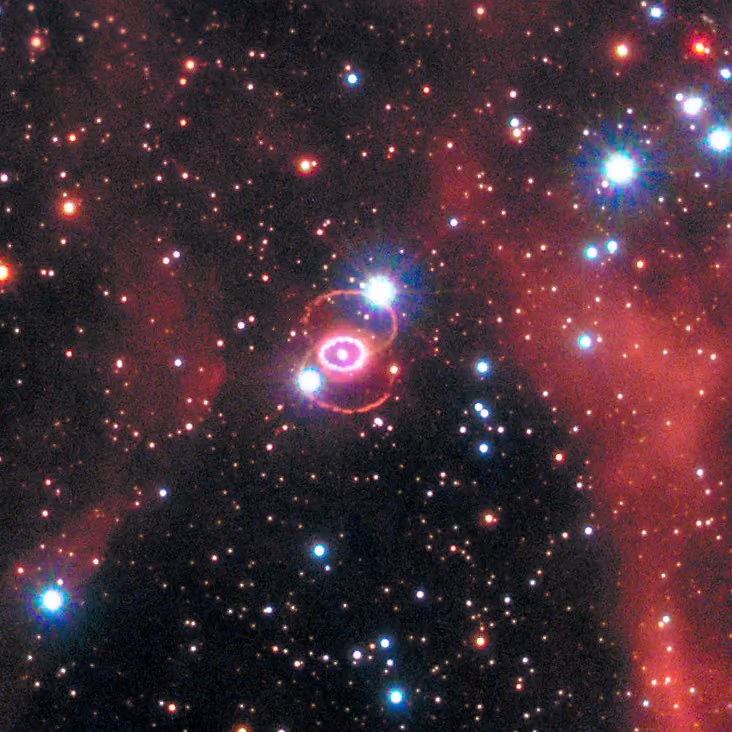
The Hubble Heritage image released on February 4, 1999, for the 12th anniversary of the explosion, shows the remnant as a nearly starlike object surrounded by an inner ring and two fainter outer rings, all set among large clouds of glowing gas. The black-and-white mosaics were donated to the project by Nino Panagia and Martino Romaniello, with the cooperation of Robert Kirshner, who led the Hubble program studying the supernova. The Heritage Team built the color version from five filters.

The rings expand slowly, about 70,000 to 100,000 miles per hour, compared with debris at the center moving 100 to 2,000 times faster. Spectra show them enriched in nitrogen. Both facts mean they were puffed out by the star more than 20,000 years before it exploded, while it was a red supergiant. Why a red supergiant would shed rings, like a pipe smoker, instead of losing material evenly in all directions, is still unclear.
The star itself was a second surprise. Observations just before the explosion showed a blue supergiant, and until 1987 theorists had expected only red supergiants to explode. The explanation offered is that the star had been a red supergiant until relatively recently, then shrank and heated up over the millennia before it died.
| Name | Supernova 1987A (SN 1987A) |
|---|---|
| Type | Remnant of a core-collapse supernova |
| Host galaxy | Large Magellanic Cloud |
| Constellation | Dorado |
| Distance | About 168,000 light-years (51.4 kiloparsecs) |
| Exploded | Seen on February 23, 1987 |
| Position (J2000) | R.A. 05h 35m 28.03s, Dec. −69° 16′ 11.79″ |
| Camera | Wide Field and Planetary Camera 2 |
|---|---|
| Observed | September 1994, February 1996, July 1997 |
| Exposure | 8.3 hours in total |
| Filters | F439W (B), F502N [O III], F555W (V), F656N (H-alpha), F675W (R) |
| Released | February 4, 1999 |
A ring that measured a galaxy
The inner ring turned into a ruler. Hubble measured its angular size precisely. The International Ultraviolet Explorer, a smaller satellite, had recorded how long after the explosion the ring brightened, 0.66 years, the time the flash took to reach it. That gives a ring diameter of 1.32 light-years. Comparing true and angular size yields a distance of about 168,000 light-years to the supernova, and so to the Large Magellanic Cloud.
That number matters well beyond this one object. The LMC holds many Cepheid variable stars, whose brightness can be calibrated once their distance is known. Calibrated Cepheids are then used to measure distances to other galaxies, and through them the scale, expansion rate and age of the cosmos.
The neighborhood of the supernova
SN 1987A sits at the edge of the Tarantula Nebula, a region where stars have formed actively for the last 20 million years. Within 90 light-years of the supernova, WFPC2 data revealed more than 20,000 stars, born in a series of bursts between 1 and 150 million years ago, on top of an older layer between 0.5 and 6 billion years old. The dozen bright blue stars near the supernova each weigh more than six times the Sun and are about 12 million years old, the same generation as the star that exploded. More than 500 fainter stars of roughly solar mass formed at about the same time.
The collision with the ring
In 1999 the fast debris was just beginning to reach the inner ring, as observations with the Space Telescope Imaging Spectrograph showed. The prediction then was that the full impact within a decade would heat the ring and light it up for years, and that within about a century the ring material would be swept away into the gas of the Large Magellanic Cloud. The 2017 Wide Field Camera 3 image at the top of this page shows the ring lit as a necklace of bright spots. Other exploded stars in the series, including the Crab Nebula, are listed in the Hubble Heritage gallery. How the five filters of the 1999 image become one color picture is covered in Are the Colors Real?.
Questions readers ask
When did Supernova 1987A explode?
Its light and neutrinos reached Earth on February 23, 1987. Because the Large Magellanic Cloud is about 168,000 light-years away, the star actually exploded about 168,000 years before that. Its nearness made it the most thoroughly observed supernova ever.
How many neutrinos were detected from SN 1987A?
Twenty-five in total: 12 at Kamiokande II in Japan, 8 at the IMB detector in Ohio and 5 at Baksan in Russia. The tiny number, out of an enormous total, was enough to confirm that the explosion came from the collapse of a massive star's core.
What are the rings around SN 1987A?
They are shells of gas the star expelled more than 20,000 years before it exploded, when it was a red supergiant. They expand slowly and are rich in nitrogen. The inner ring is now being hit by fast debris from the explosion, which makes it glow.
How did SN 1987A help measure distances in the universe?
Hubble measured the angular size of the inner ring, and the time it took the flash to light it gave its true size, 1.32 light-years across. Together they give a distance of about 168,000 light-years to the Large Magellanic Cloud, which is used to calibrate Cepheid stars and the distance scale beyond.